Kitchen Laminates Guide 2026: Best Finishes for Modular Kitchens in India
The finish on your shutters decides how your kitchen looks on day one and how it ages through years of tadka, steam and daily wiping. Here's how the main options compare.

Key takeaways
- Matte laminates are the easiest to live with in a heavy-cooking Indian kitchen: they hide fingerprints and fine scratches.
- High-gloss acrylic looks the most premium but shows every smudge and usually costs noticeably more than laminate.
- Wood-grain and textured laminates give the warmth of timber without the upkeep of real veneer.
- Mixing finishes, like matte base units with gloss overheads, balances practicality and looks.
- Laminate is only the skin. The board underneath (BWP ply or HDHMR) matters just as much for durability.
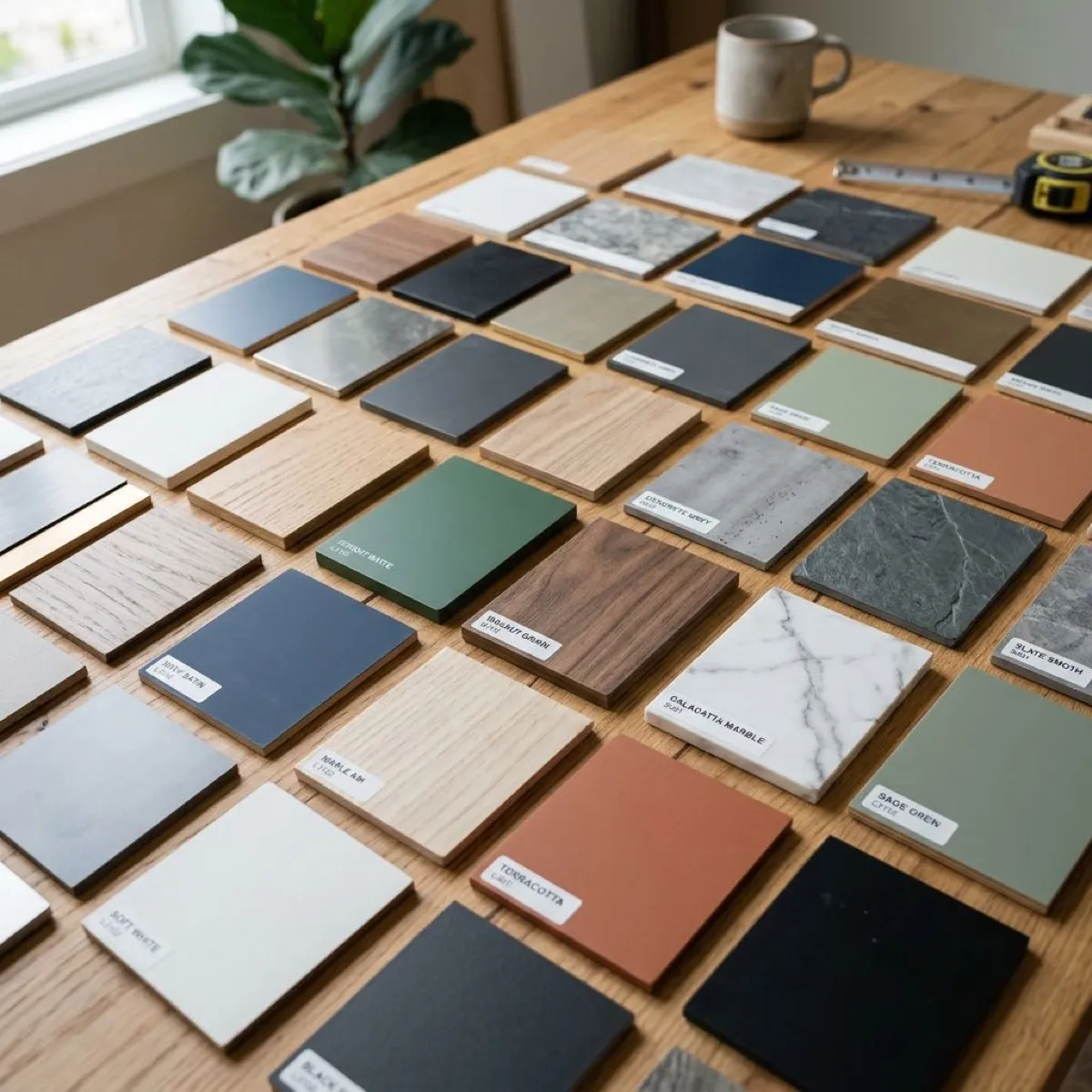
Ask any homeowner what they remember about choosing their kitchen and most will mention one moment: standing in front of a wall of sample chips, trying to picture a 4-inch square as an entire kitchen. Laminates are the skin of a modular kitchen. They take the fingerprints, the oil splashes and the daily wipe-down, and they set the mood of the room.
Getting the choice right is less about trends and more about matching the finish to how your household actually cooks. Below, we break down the finishes most Indian homeowners choose between, what each one is good and bad at, and how designers combine them. Want to see how matte, acrylic, or wood-grain shutters will look in your actual kitchen before ordering sheets? Upload a photo to our AI 3D Kitchen Redesign Studio or check the price difference across finishes on our 60-Second Modular Kitchen Cost Calculator.
What exactly is a kitchen laminate?
A high-pressure decorative laminate (HPL) is a multi-layer sheet crafted from phenolic-impregnated kraft paper and a melamine-treated decorative print layer, bonded onto the cabinet board under high heat and pressure. In India, exterior-grade shutter laminates should conform to Bureau of Indian Standards (BIS) IS:2046 specifications with a minimum thickness of 1.0 mm on external shutter faces (and 0.8 mm white balancing liner on internal faces) to resist boiling water, dry heat up to 180°C, and turmeric staining.
It's worth separating two decisions that often get blurred in showrooms:
- The board: usually IS:710 BWP (boiling water proof) plywood, commercial plywood, HDHMR or MDF. This decides structural strength and water resistance.
- The finish: laminate, acrylic, PU paint or veneer. This decides looks, feel and day-to-day maintenance.
A beautiful finish on a weak board will still fail, especially around the sink. Our Delhi NCR kitchen cost guide covers board choices in more detail.
1. High-gloss acrylic: the showpiece finish
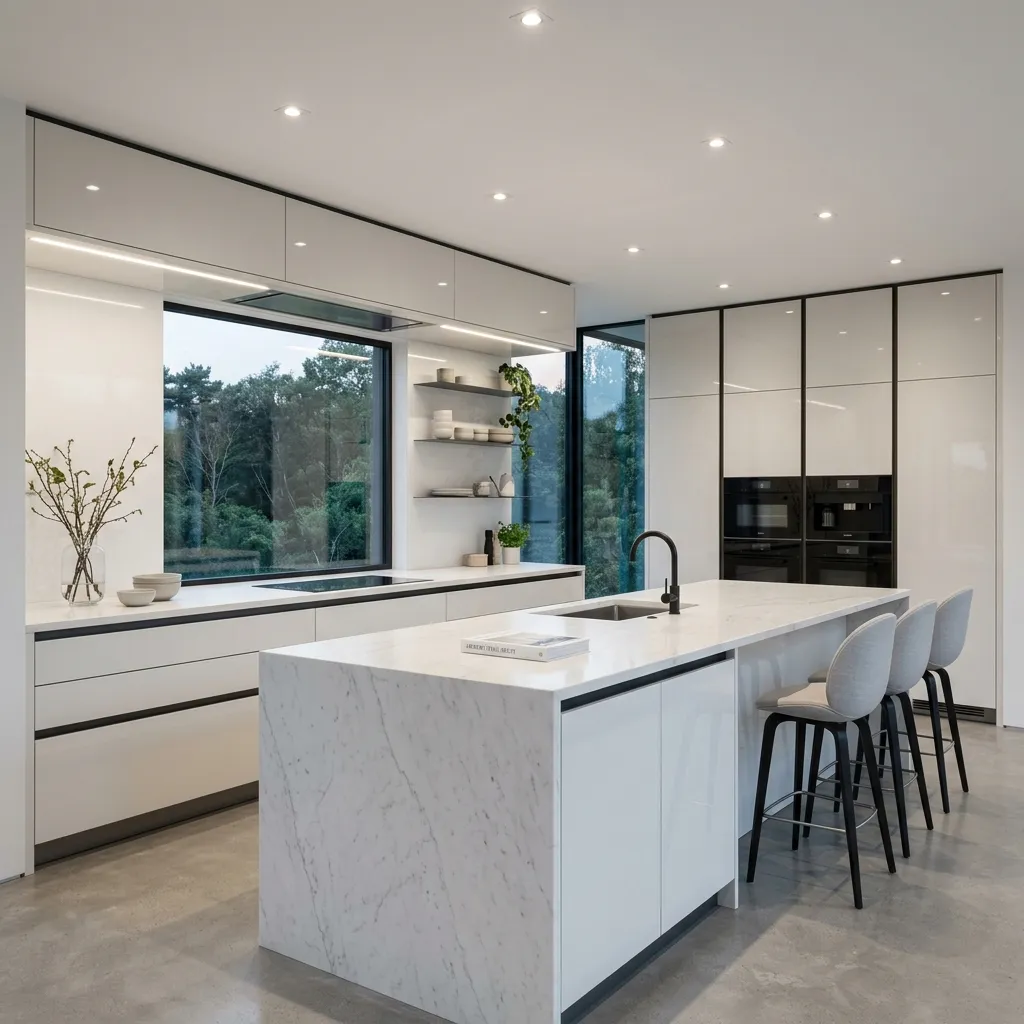
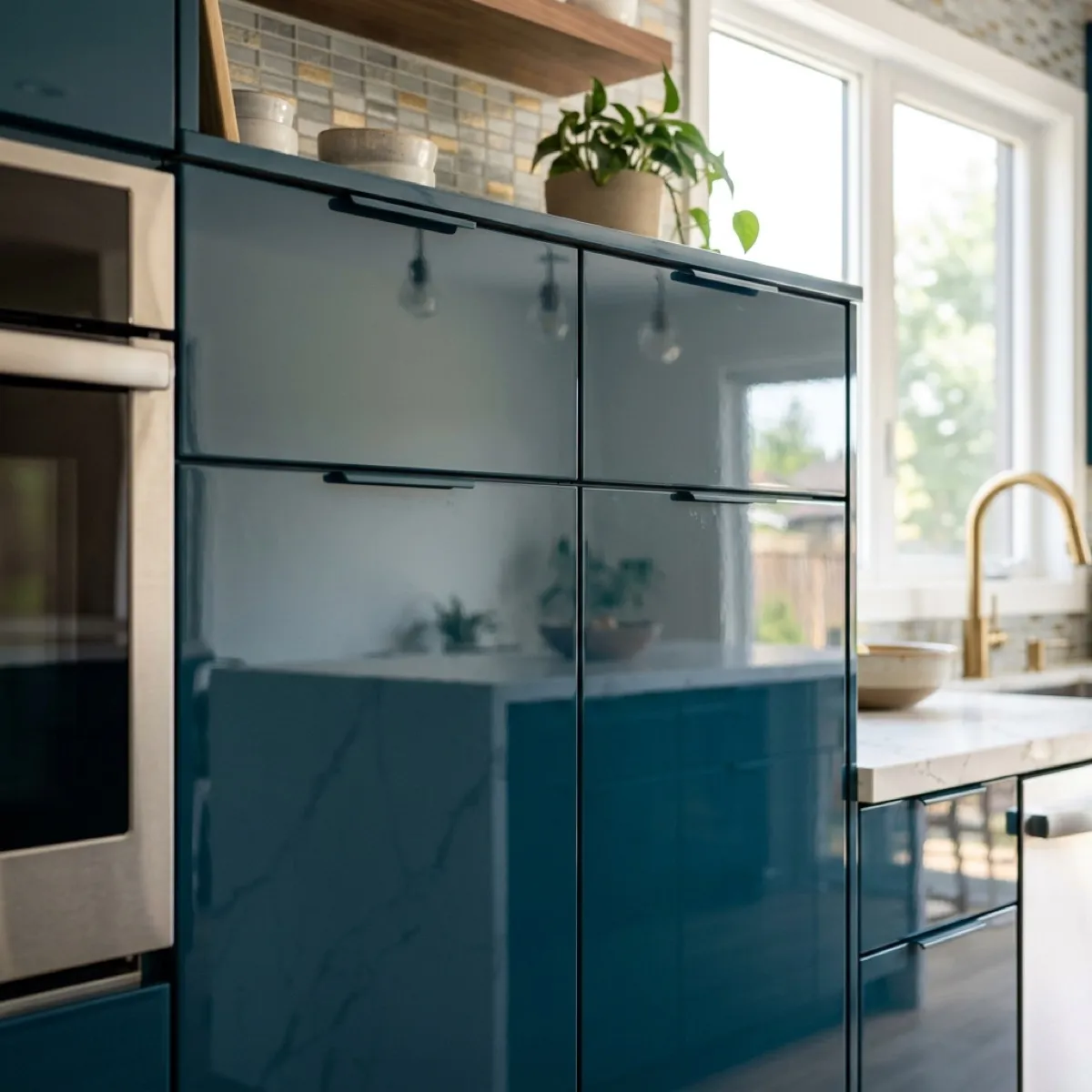
Acrylic gives a deep, mirror-like shine that bounces light around the room. In compact city apartments it can make a kitchen feel noticeably brighter and larger, which is why it's popular in contemporary flats across Gurugram and Noida.
Where it works
Overhead cabinets, tall units and kitchens that open into a living area, where the kitchen is on display and gets less direct splash.
Watch out for
- Fingerprints and smudges show clearly, especially on dark colours.
- Fine scratches are visible under direct light. Use a soft microfibre cloth, never abrasive scrubbers.
- Substrate flatness: 1.5 mm to 2.0 mm acrylic sheets require a perfectly calibrated substrate (typically 18 mm calibrated HDHMR or calibrated BWP plywood) so the mirror reflection never ripples or warps.
- Cost: acrylic is typically a step up in price from standard laminate. High-gloss laminate gives a similar look for considerably less.
2. Matte laminates: the practical favourite
Matte finishes diffuse light instead of reflecting it, which gives a soft, calm look that suits modern minimal kitchens. More importantly for Indian cooking, they are forgiving. Fingerprints, water marks and light scuffs are far less noticeable.
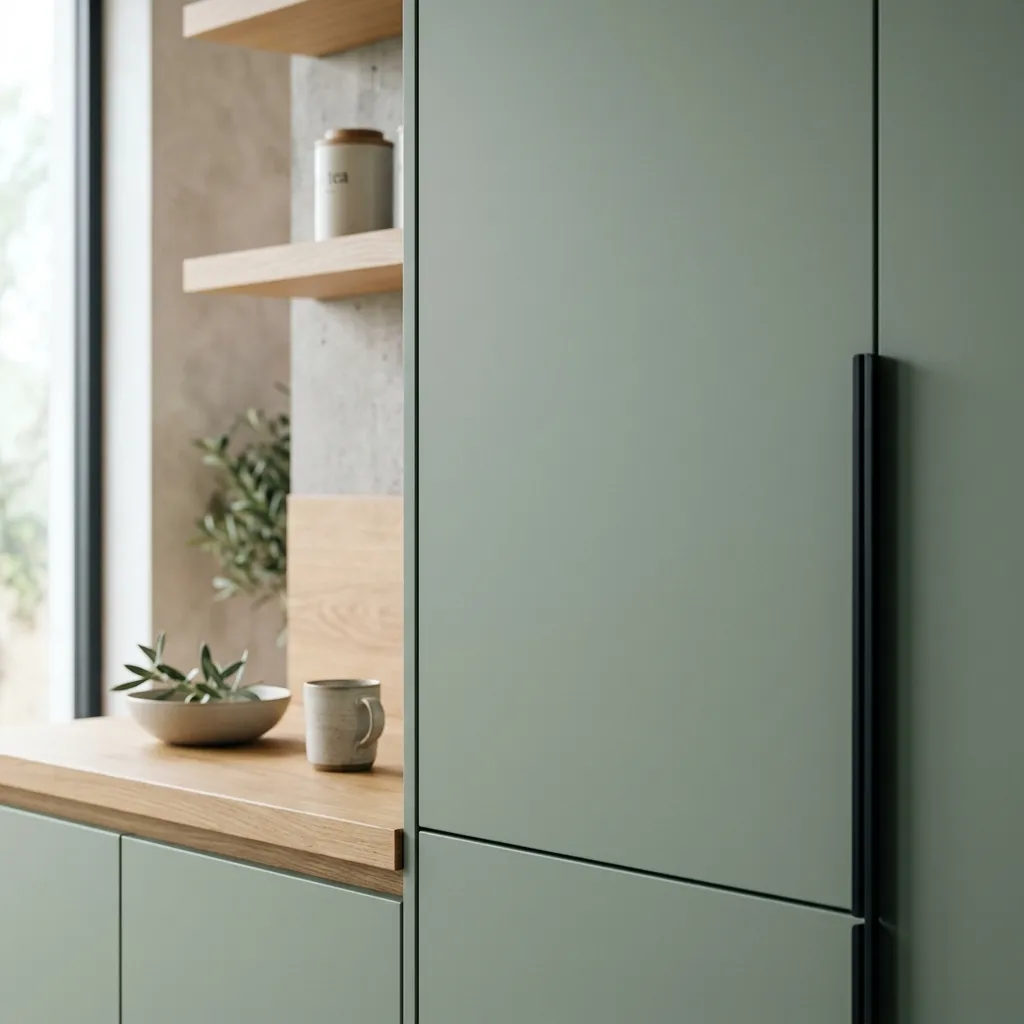
Newer "anti-fingerprint" or zero-reflection super-matte laminates (using electron-beam cured acrylic resin overlays) go a step further with a velvety, low-porosity surface that repels skin oils and thermal micro-scratches. They usually cost more than standard matte, so ask to see and touch a sample—and test it with a drop of haldi and oil—before committing.
3. Wood-grain and textured laminates: warmth without the upkeep
Real wood veneer is beautiful but needs care around heat and moisture. Textured wood-grain laminates replicate the look, and often the feel, of timber, while being far more tolerant of a busy kitchen.
- Horizontal grain visually widens a narrow kitchen.
- Vertical grain draws the eye up and makes ceilings feel taller.
- Deep-textured or "synchronised" grain, where the texture follows the printed pattern, feels closest to real wood.
Wood-grain pairs especially well with white or light-grey solids. A wood-tone base with light overheads is one of the most requested combinations we build across Delhi, Faridabad, and Ghaziabad.
4. Beyond laminate: PU paint and veneer
You will often see these alongside laminates in a quotation, so it helps to know where they sit:
- PU (polyurethane) paint gives a seamless, edge-free painted finish sprayed onto routed HDHMR shutters in almost any RAL/dulux shade, in matte or high gloss. It sits at the luxury end and can be polished or spot-repaired, though it requires dust-free spray booths and longer factory lead times.
- Natural veneer is a thin slice of real timber bonded to plywood and sealed with clear PU. It is unmatched for organic luxury in dry bar units or island fronts, but demands more care in wet and high-heat tadka zones.
Why Edge Banding and Hardware Pairing Decide How Your Finish Ages
Even the finest 1.0 mm Greenlam, Merino, or Royale Touche laminate will fail within two summers if the factory cuts corners on edge sealing and balancing. When evaluating quotes, check three critical engineering details:
- Reactive PUR vs. Standard EVA Edge Banding: Most local workshops glue PVC edge tape using standard EVA (ethylene-vinyl acetate) hot-melt glue, which softens at 75–80°C when exposed to rising steam from pressure cookers, kettles, or ovens. At Gharwaala's Okhla factory, shutters are sealed with moisture-curing PUR (polyurethane) adhesive, which cross-links chemically to withstand temperatures up to 140°C and creates a near-invisible zero-joint line on acrylic and matte shutters.
- Balanced Double-Sided Pressing: If a 1.5 mm acrylic or 1.0 mm laminate sheet is cold-pressed onto the front of an 18 mm shutter while a cheap 0.5 mm liner is used on the back, differential tension will bow the shutter over 6–12 months. Always insist on a matched 0.8 mm or 1.0 mm balancing laminate on the rear face.
- Hinge Cup Calibration for Heavy Shutters: Dense 18 mm HDHMR shutters clad with acrylic or multi-coat PU weigh significantly more than basic commercial ply doors. Pairing them with engineered soft-close systems like Blum CLIP top BLUMOTION or Hettich Sensys—and adding a third hinge on any shutter taller than 900 mm—prevents shutter sag and keeps shadow gaps razor-straight.
Side-by-side comparison
| Finish | Look | Shows fingerprints? | Scratch tolerance | Relative cost |
|---|---|---|---|---|
| Matte laminate (1.0 mm) | Soft, modern | Rarely | Good | ₹ |
| High-gloss laminate (1.0 mm) | Shiny, bright | Yes | Moderate | ₹ |
| Wood-grain / synchronised | Warm, natural | Rarely | Very good | ₹–₹₹ |
| Anti-fingerprint super-matte | Velvety, ultra-low sheen | Almost never | Very good (thermal healing) | ₹₹ |
| Acrylic (1.5–2.0 mm) | Mirror gloss, premium | Yes, clearly | Moderate | ₹₹ |
| PU paint (automotive grade) | Seamless, custom colour | Depends on sheen | Moderate (repairable) | ₹₹₹ |
How designers mix finishes
A dependable formula: hard-wearing matte on the base cabinets, where feet, kids and spills do their damage, and a lighter gloss or acrylic on the overheads to bring light into the room.
Other combinations that work well in Indian homes:
- Wood-grain base with white gloss overheads: warm and timeless.
- Two-tone matte (for example sage base with off-white top): calm, low-maintenance and on-trend.
- Accent tall unit: one feature colour on the pantry or appliance tower, with neutrals elsewhere.
Browse real combinations in our kitchen design gallery.
A quick checklist before you choose
- How heavily do you cook? Daily frying and tadka points towards matte or textured finishes near the hob.
- How much light does the kitchen get? Dim kitchens benefit from lighter, glossier surfaces.
- Is the kitchen open to the living room? If yes, it's on display, so it may be worth spending on overhead finishes.
- Have you seen a full-size sheet? Small chips can be misleading. Ask to see a large sample under your own lighting.
- What edge banding is used? Matching, PUR-sealed 1.0–2.0 mm PVC edge banding prevents moisture getting into the board.
The verdict
There's no single "best" laminate, only the best one for your routine. If you want a kitchen that still looks clean at the end of a long cooking day, start with matte or textured finishes for the base. If you want drama and light, use gloss or acrylic where it's least likely to be splashed. And whichever finish you pick, make sure the board underneath is right for the job.
Frequently asked questions
Which laminate finish is best for an Indian kitchen?
For most Indian kitchens with daily heavy cooking, matte or textured laminates are the most practical choice because they hide fingerprints, oil marks and minor scratches. Gloss or acrylic works well on overhead cabinets where there is less splash.
Is acrylic better than laminate for kitchen cabinets?
Acrylic gives a deeper, more premium gloss and is moisture resistant, but it shows smudges and fine scratches more easily and usually costs more. High-gloss laminate offers a similar look at a lower price with slightly less depth of shine.
Do glossy kitchen cabinets show fingerprints?
Yes. High-gloss laminates and acrylic show fingerprints and smudges more than matte finishes, especially in darker colours. Anti-fingerprint matte laminates are designed to reduce this.
How do I clean laminate kitchen cabinets?
Wipe with a soft microfibre cloth and mild soapy water, then dry. Avoid abrasive scrubbers, steel wool and harsh solvents, particularly on gloss and acrylic surfaces.
Planning a kitchen in Delhi NCR?
Get a free, itemised estimate and a 3D design consultation from our kitchen designers.