Open vs Closed Kitchen: Which Is Better for Indian Homes?
Open kitchens dominate design magazines. Indian cooking, with its tadka, frying and lingering masala, makes the decision more complicated. Here's how to choose.

Key takeaways
- Open kitchens feel larger and more social but need strong ventilation for Indian cooking.
- Closed kitchens contain smoke, smells, noise and clutter, which suits daily heavy cooking.
- Semi-open layouts with glass partitions or sliding doors are a popular middle ground.
- For open kitchens, a high-suction chimney (around 1200 m³/hr or more) is essential.
- Choose by cooking style first, then by space and how you entertain.
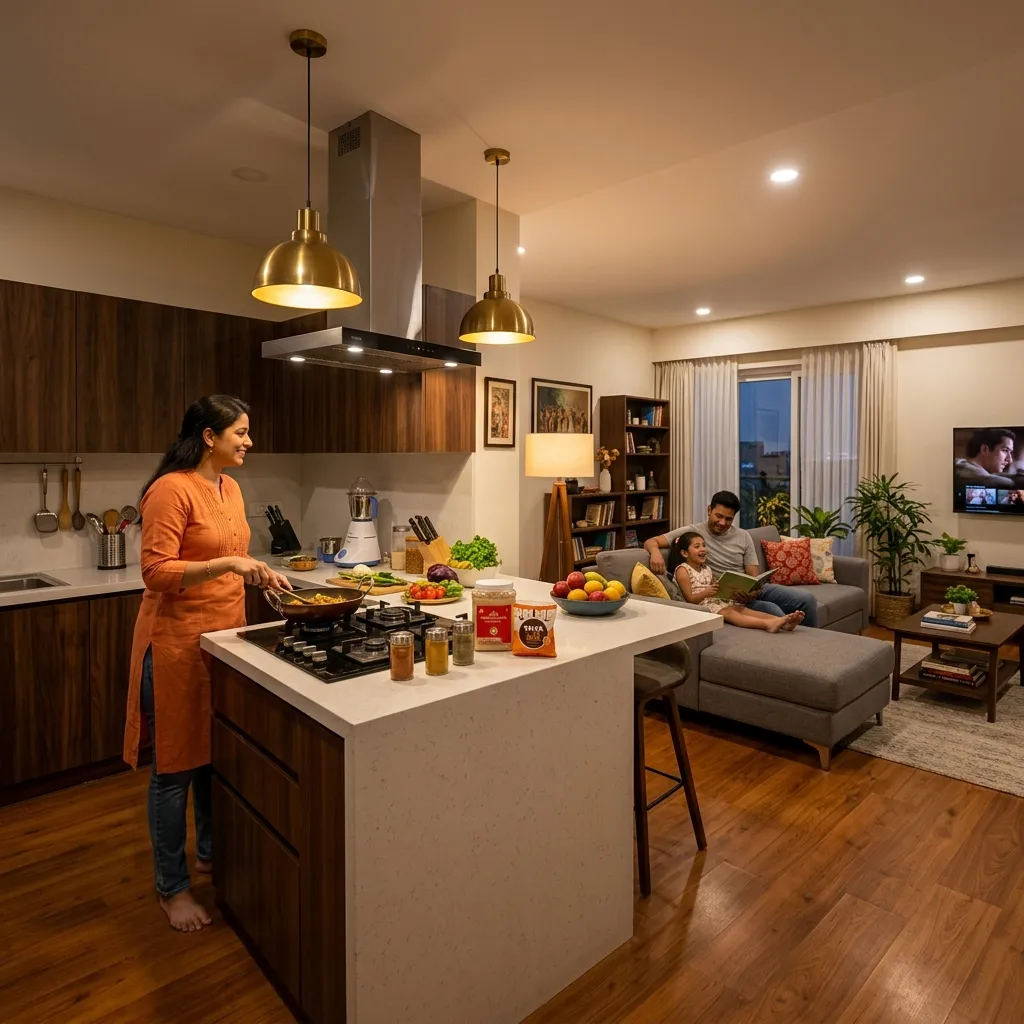
The open kitchen is one of the most requested features in new Indian homes, and one of the most argued about at the dinner table. One family member pictures chatting with guests while cooking; another pictures the living-room sofa smelling of last night's hing and jeera tadka.
Both are right. The best layout depends on how your household cooks, how your chimney ducting is routed, and how you use the rest of your home. Want to see how removing a wall or adding a fluted-glass breakfast partition would look in your own flat? Upload a photo of your current kitchen to our AI 3D Kitchen Redesign Studio or compare layout budgets in our 60-Second Modular Kitchen Cost Calculator.
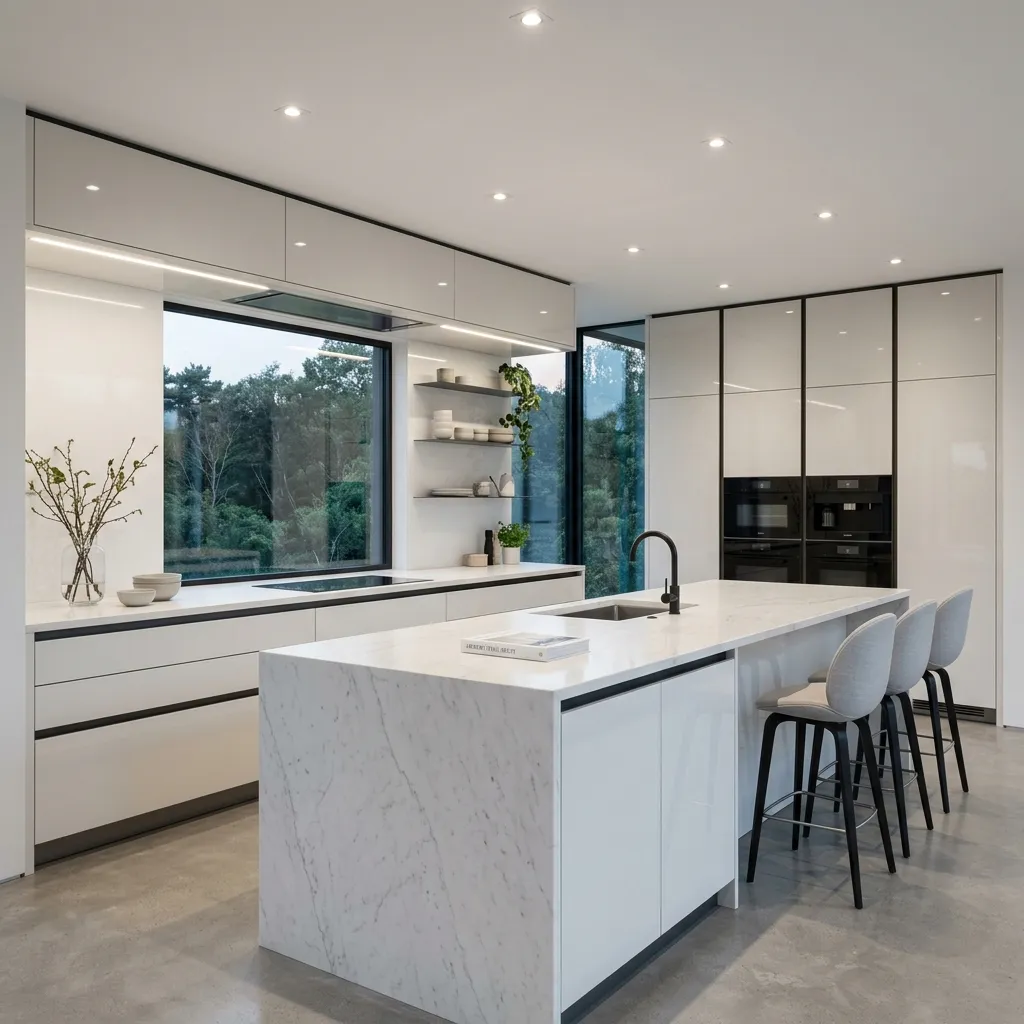
The case for open kitchens
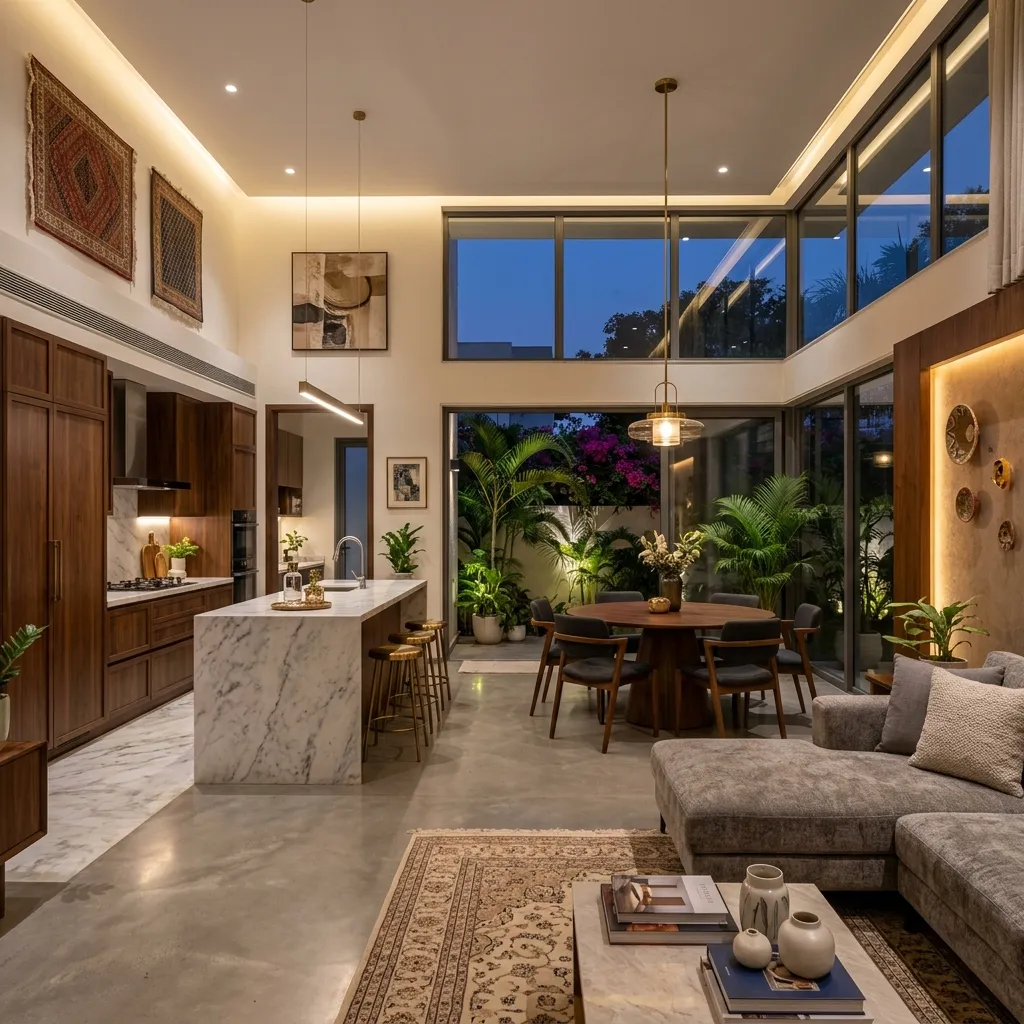
- More space and light. Removing a masonry wall makes compact 2BHK and 3BHK apartments feel 25–30% larger and lets balcony daylight reach the kitchen counter.
- More social. Cooking stops being solitary; you can talk to family, watch children, or host guests while plating meals.
- Flexible island & peninsula storage. A 600–750 mm deep breakfast counter fitted with full-extension Blum or Hettich tandem drawers on the kitchen side doubles as a dining bar, baking station, and serving buffet.
- Better cross-breeze and AC comfort. In hot Delhi NCR summers, an open or semi-open kitchen benefits from the living-room air conditioning rather than turning into a 40°C sauna.
The case for closed kitchens
Indian cooking involves high-heat tempering (tadka), shallow-frying parathas, pressure-cooking dals, and grinding masalas—processes that release fine oil aerosols and aromatic compounds that linger for hours. A closed kitchen physically isolates smoke, grease film, mixer-grinder noise, and sink clutter from your living room upholstery, curtains, and rugs.
- Contains oil aerosol and smells. Vaporised mustard or ghee droplets don't settle on living-room fabrics or chandeliers.
- Hides active prep clutter. No pressure to clear every kadhai and chopping board before guests sit down in the drawing room.
- Quieter home (15–20 dB reduction). Pressure cooker whistles, 750W wet grinders, and high-RPM chimney blowers stay behind a closed door.
- More full-height wall storage. Keeping the third or fourth wall intact provides extra running feet for tall appliance towers and overhead cabinets.
Open vs closed vs semi-open: side by side
| Factor | Open Kitchen | Closed Kitchen | Semi-Open (Glass Partition) |
|---|---|---|---|
| Tadka smoke & oil film | Spreads if chimney/duct is weak | Fully contained | Contained when sliders close |
| Chimney suction required | 1,350–1,600 m³/hr (BLDC baffle/filterless) | 1,000–1,200 m³/hr standard | 1,200–1,400 m³/hr |
| Sense of space & daylight | Maximum openness | Can feel boxed-in | 90% of open-plan light |
| Living-room AC sharing | Always connected (higher AC load) | None (hotter in summer) | On-demand cooling control |
| Wall cabinet storage | Loses 1 wall (gains island base) | Maximum wall area | Keeps half-wall + overhead bridge |
| Appliance & grinder noise | Travels into living/TV zone | Isolated | Dampened by 8–10 mm glass |
| Visual upkeep | Must stay showroom-tidy | Forgiving of sink clutter | Fluted/ribbed glass blurs clutter |
The middle ground: semi-open kitchens
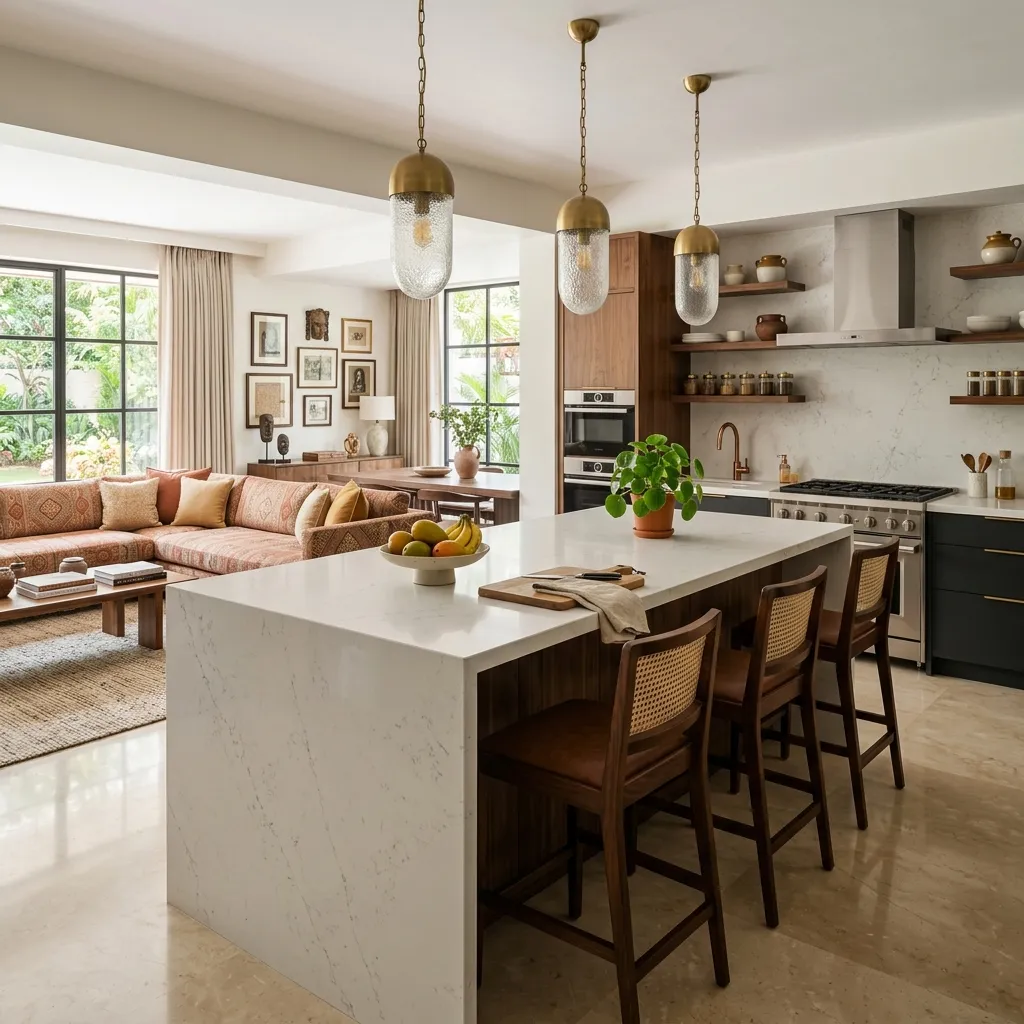
Over 65% of the homeowners we consult across Delhi NCR now choose a semi-open hybrid layout, which captures the daylight and social connection of an open plan while physically blocking tadka smoke when needed:
- Top-hung fluted glass sliding partitions: Slim black-anodised aluminium frames glazed with 8 mm or 10 mm toughened fluted (reeded) glass conforming to Bureau of Indian Standards (BIS) IS:2553 safety glass norms. Suspended on Häfele Slido or Hettich top-hung tracks, there is zero floor track to trap dirt or trip over, and the ribbed texture hides sink dishes while letting 85% of natural light pass through.
- Breakfast counter with folding glass bi-folds above: A 42-inch-high quartz peninsula separates the floor zones, while casement or bi-fold glass windows above the counter fold completely open during parties and latch shut during heavy frying.
- Wet and dry kitchen split: An open "show" pantry/island with induction hob, coffee station, and built-in oven facing the dining room, paired with a compact 45 sq ft enclosed utility/wet kitchen behind a pocket door for heavy tadka and dishwashing.
Ventilation engineering: non-negotiable for open kitchens
If you choose an open or semi-open kitchen, buying a chimney advertised at "1,400 m³/hr" is only half the battle. In real site testing, poor duct geometry destroys up to 40% of a chimney's rated suction:
- Use 6-inch (150 mm) rigid PVC or smooth aluminium ducting: Never let installers neck down a high-suction chimney to a 4-inch flexible accordion hose; corrugated ridges create turbulence, grease build-up, and a loud whistling roar.
- Minimise 90° bends: Every sharp 90° elbow in the chimney duct adds static pressure equivalent to 1.5 metres of straight pipe and cuts effective extraction by 12–15%. Keep the total duct run under 3 metres with at most two 45° or swept bends.
- Mind the AC drafts: Never position a living-room split AC blower or ceiling fan so its air stream blows directly across the hob; cross-drafts push rising tadka plumes sideways before they reach the chimney hood capture zone (mounted 650–720 mm above the burners).
2026 Cost of Converting a Closed Kitchen to Open or Semi-Open (Plus RWA Rules)
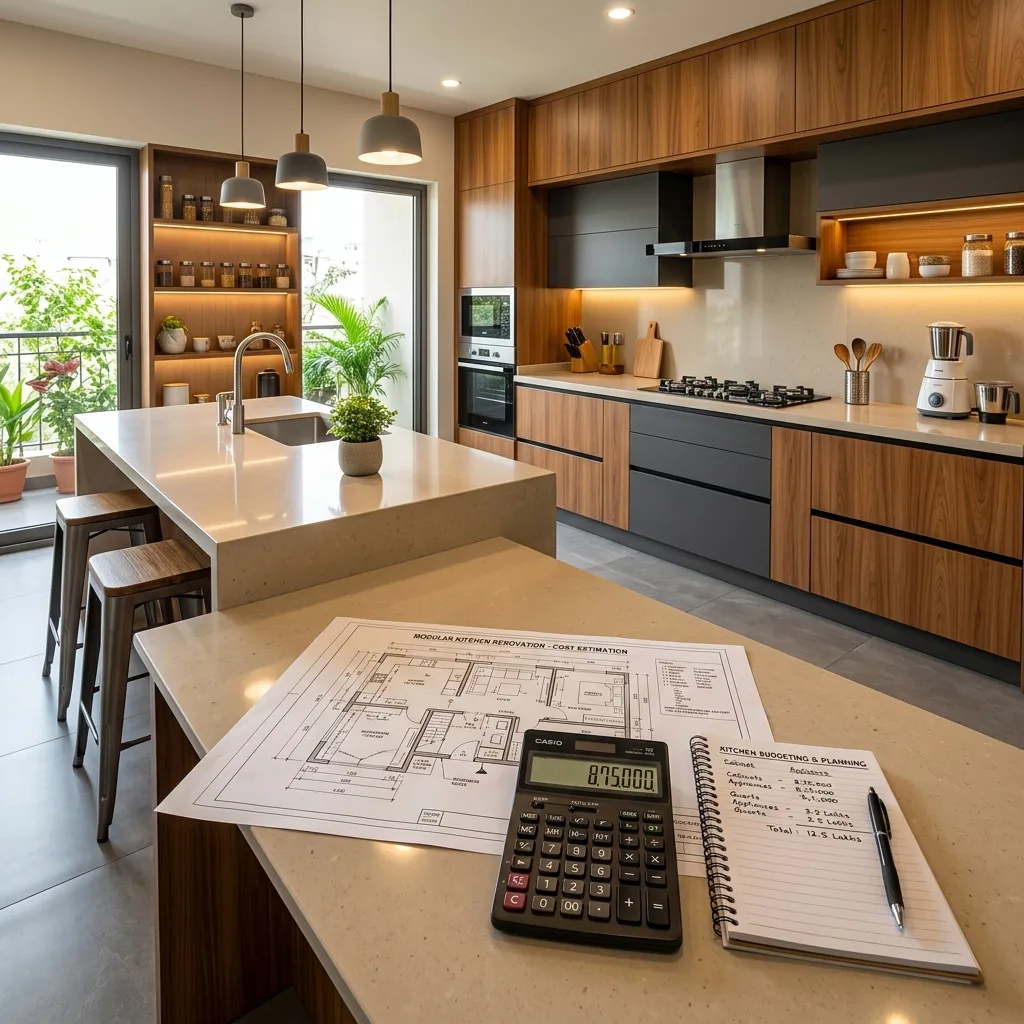
Before taking a sledgehammer to your kitchen wall in Gurugram, Noida, Delhi, Faridabad, or Ghaziabad, factor in both structural rules and civil conversion costs:
- Shear Wall vs. Non-Load-Bearing Partition Check: In modern Mivan/aluminium-formwork high-rises in Noida Expressway, Greater Noida West, and Golf Course Extension Road (Gurugram), external and internal walls are often poured-concrete structural shear walls that cannot be demolished. In conventional RCC column-and-beam towers or Delhi builder floors, the 4.5-inch brick or AAC block kitchen wall is usually non-structural and safe to remove after verifying the society structural drawing and obtaining an RWA NOC.
- Wall Demolition, Debris & Floor Patching (₹18,000–₹32,000): Breaking a 10-foot partition wall requires cutting concealed electrical conduits, carting away malba in society-approved bags, and inlaying matching vitrified tiles or a contrasting quartz threshold strip where the wall stood.
- Breakfast Counter + Quartz Waterfall Top (₹45,000–₹75,000): Adding a 5-foot peninsula with IS:710 BWP/HDHMR base storage, two-sided shutters, and a 20 mm quartz countertop with a mitred waterfall leg.
- Slim Aluminium & Fluted Toughened Glass Sliding Partition (₹55,000–₹95,000): Custom powder-coated slim-profile telescopic or synchronised sliding doors (₹1,150–₹1,650 per sq ft) that give you both an open and closed kitchen on demand. See how these affect total project budgets in our Delhi NCR modular kitchen cost guide and our guide to saving on custom cabinets.
How to decide: a quick checklist
- How often do you deep-fry or do heavy tadka? Daily points towards closed or a fluted-glass semi-open layout.
- Do you entertain or supervise kids while cooking? Frequently points towards open or semi-open.
- Can you run a 6-inch rigid chimney duct under 10 feet to an external shaft? If not, avoid fully open.
- Do you have a house help who cooks while the family uses the living room? Many households prefer a sliding partition for acoustic and visual privacy during peak prep hours.
The verdict
The right choice depends on your family's cooking habits. If you cook light meals and entertain often, go open—with a 1,400+ m³/hr chimney and proper 6-inch ducting. If your family does heavy Indian cooking every day, a closed or semi-open layout will save a great deal of cleaning in the long run. For most Delhi NCR homes we work on, a semi-open kitchen with a breakfast counter and a fluted glass sliding partition is the smartest balance.
Browse open, closed and semi-open layouts in our kitchen design gallery.
Frequently asked questions
Is an open kitchen good for Indian cooking?
An open kitchen can work for Indian cooking if you install a powerful chimney (around 1200 m³/hr suction or more) and ensure good cross-ventilation. For daily heavy frying and tadka, a closed or semi-open kitchen usually keeps the home cleaner.
What is a semi-open kitchen?
A semi-open kitchen is partially separated from the living area by a glass partition, sliding door, half-wall or breakfast counter. It keeps visual connection and light while containing smoke and smells.
Which is better for a small apartment: open or closed kitchen?
Open kitchens make small apartments feel larger and brighter, but closed kitchens offer more storage and contain smells. A semi-open layout with a glass partition is often the best compromise for compact homes.
Can I convert my closed kitchen into an open kitchen?
Often, yes, but first confirm the wall is not structural and check society or builder rules. Plan electrical, plumbing and chimney ducting changes at the same time.
Planning a kitchen in Delhi NCR?
Get a free, itemised estimate and a 3D design consultation from our kitchen designers.